The Ultimate Guide to Challenge Coins: History, Tradition, and ADF Etiquette
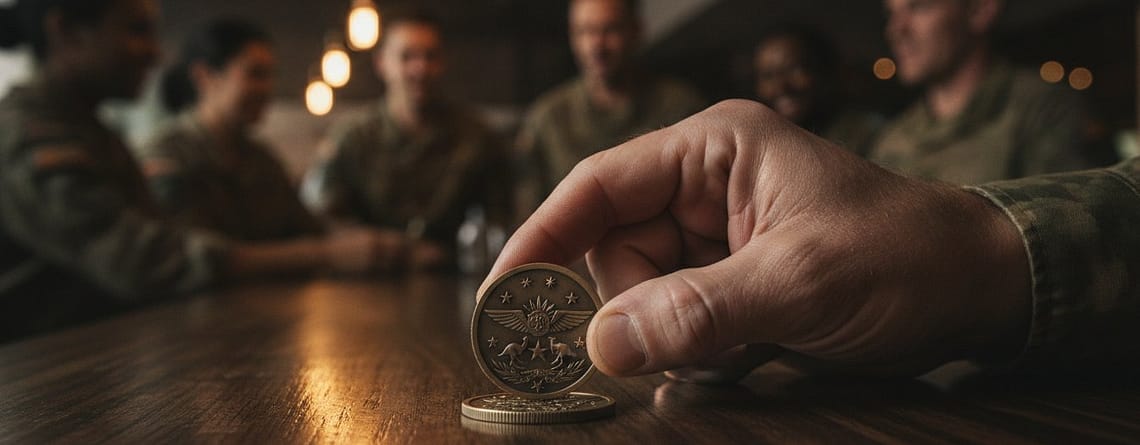
Imagine you’re at the boozer after a long rotation, and the distinct clatter of metal hitting the timber bar stops the conversation dead. If you can’t produce your own challenge coin in that moment, you’re likely buying the next round for the entire section. It’s a tradition that builds an unbreakable bond among those who serve; however, the unwritten rules can feel like a bit of a minefield if you’ve never been briefed on the proper protocol.
We understand that these coins are far more than just metal tokens. They’re a “handshake in metal” that represents shared sacrifice and unit identity. In this guide, you’ll discover the deep-rooted history of military challenge coins and learn the essential etiquette for carrying these symbols of Australian Defence Force pride. We’ll walk you through the protocol of the “challenge,” explain how to display your collection with dignity, and show you how to design a meaningful unit coin that honours your specific legacy. Whether you’re a new recruit or a seasoned veteran, this overview provides the clarity you need to respect the tradition and the community it represents.
Key Takeaways
- Trace the lineage of these medallions from Roman battlefields to the legendary stories of the Great War.
- Master the unwritten social protocols of the ADF canteen to ensure you’re never caught without your challenge coin when the call is made.
- Discover the essential design elements, including the Rising Sun and unit-specific heraldry, needed to create a lasting tribute that honours your service.
- Gain insight into why a veteran-owned perspective is vital for ensuring your unit’s heritage is treated with the dignity and accuracy it deserves.
What is a Challenge Coin? Defining the ADF Tradition
A challenge coin is a small, custom-designed medallion bearing a unit’s crest, insignia, or unique identifiers. Within the Australian Defence Force, these coins represent a tangible link to a member’s service, their specific unit, or a particular deployment. While official medals are awarded through formal channels for bravery or long service, the challenge coin serves as a symbol of belonging and excellence in the Australian military that is often more personal in nature. They are unofficial items; however, they carry immense social and professional weight within the ranks. Carrying one signifies that you are part of a specific story, a shared history that only those who have stood in the same boots can truly understand.
The Anatomy of an Australian Military Coin
The physical design of an Australian military coin is a deliberate exercise in heraldry and history. Most are struck from durable materials like brass or zinc alloy, finished with vibrant enamel to make the unit colours stand out. Common features include the iconic Rising Sun badge, unit mottos, and specific colour palettes that reflect the corps or service branch. These coins often utilise dual-sided storytelling. One side typically displays the permanent unit insignia, such as the 1RAR or 3RAR crests. The reverse side is frequently dedicated to a specific mission, a tour of duty, or a milestone anniversary. This allows the coin to capture a moment in time, serving as a permanent record of a member’s contribution to a specific operation or era of service.
Why ADF Members Carry Them Today
The practice of carrying these coins has become a cornerstone of building unit cohesion and esprit de corps, particularly during difficult deployments overseas. They offer a way to recognise excellence and hard work without the rigid formality of official commendations. A Commanding Officer might present a coin to a digger who has gone above and beyond, making it a highly prized mark of peer-to-peer respect. Beyond individual recognition, they are used to commemorate significant events, such as the decommissioning of a storied unit or the centenary of a historic battle. For many veterans, the coin remains in their pocket long after they have hung up the uniform. It serves as a constant, quiet reminder of the mateship and duty that defined their time in the ADF.
The History of the Challenge Coin: From Rome to the RAAF
The lineage of the modern challenge coin stretches back much further than many realise, finding its earliest echoes in the legions of Ancient Rome. When a soldier performed with distinction on the battlefield, he was often awarded a bonus coin in addition to his daily pay. These were not ordinary pieces of currency. They were specially minted with the mark of the legion, designed to be kept as a permanent testament to the soldier’s valour. This ancient practice established the coin as a symbol of merit rather than mere monetary value, a sentiment that still underpins the tradition today.
During the First World War, the lore surrounding the military challenge coin history grew significantly through the story of a wealthy American lieutenant. As the legend goes, he commissioned bronze medallions for his squadron. When one pilot was shot down and captured by German forces, he escaped to French lines but lacked any identification. He was nearly executed as a saboteur until he produced his squadron coin, which the French recognised, sparing his life. While many versions of this story exist, it highlights the coin’s role as a vital proof of identity and loyalty in the chaos of war.
The modern iteration of the tradition was further refined during the Vietnam War. Elite Special Forces units began carrying coins as a way to verify membership in clandestine groups, often using them in the informal “challenge” games that became staples of military canteens. By the time the tradition migrated to Australia, it was quickly embraced by the Australian Defence Force. It found a natural home in the mess life of the Army, RAAF, and Navy, where the exchange of coins became a respected method of acknowledging shared service and professional respect between allies.
The Australian Adoption
In the late 20th century, the ADF transitioned from using simple tokens to commissioning high-quality, bespoke coins. Australian units began to infuse these items with local iconography, such as the Rising Sun or unique unit mascots. Today, the “Commander’s Coin” has become a vital tool in military diplomacy. When Australian officers engage with foreign counterparts, the exchange of a unit coin serves as a “handshake in metal,” cementing partnerships and acknowledging mutual respect between nations.
Evolution of Design and Craftsmanship
The craftsmanship behind these items has evolved significantly from simple stamped metal. Modern designs often feature intricate 3D textures, high-relief detailing, and even practical integrations like bottle openers. Many units now prefer veteran-designed coins that capture specific “digger” humour or subtle unit-specific details that an outsider might miss. Ensuring the dignity of unit insignia requires high-quality manufacturing, which is why many choose to work with a veteran-owned supplier who understands the weight of the heritage involved. This shift toward bespoke, high-quality production ensures that every coin remains a lasting tribute to those who carry it.
Challenge Coin Etiquette: The Rules of the Game
The “Challenge” is a time-honoured tradition typically played in military canteens or messes to build camaraderie and reinforce the bonds of service. While the origins are storied, the modern application is a social contract between mates. Understanding the unwritten rules is essential for any member of the ADF who carries a challenge coin. It’s not just a game; it’s a test of preparedness and a shared acknowledgment of unit pride. These informal protocols ensure that the significance of the medallion is never taken for granted during social gatherings.
There are three primary rules that govern the etiquette of the challenge. First, you must carry your unit coin at all times. A challenge can happen anywhere, from a formal dinner to a casual gathering at the local boozer. Second, the initiator must clearly state the challenge. This is often done by tapping the coin firmly on a bar or holding it aloft for all to see. Finally, if you are challenged and cannot produce your coin, you are obligated to buy a round of drinks for the entire group. It’s a high-stakes tradition that ensures every member stays connected to their unit’s symbol at all times.
How to Initiate and Respond to a Challenge
Initiating a challenge requires a specific protocol to be followed. Most commonly, a member will “slam” their coin onto the bar or “clink” it against a hard surface to signal the start. Once the signal is given, every other member present has a limited time to produce their own coin. If everyone successfully produces their coin, the tables are turned. In this scenario, the original challenger is the one who must buy the round for the group. This safeguard prevents frivolous challenges and keeps the tradition grounded in mutual respect rather than just a way to get a free drink.
One must also be wary of the “accidental” challenge. If you accidentally drop your coin and it hits the floor with a distinct metallic ring, it’s often considered a self-initiated challenge. Everyone around you can immediately produce their coins, and because you technically “initiated” the event by dropping it, you’ll be the one heading to the bar. It’s a lighthearted way to ensure that these significant items are handled with the care they deserve and are never treated as mere pocket change.
Carrying and Displaying with Respect
Respect for the coin extends to how it is carried and maintained. You should never drill a hole in a coin to use it as a keyring. This is widely seen as a sign of disrespect toward the unit insignia and the heritage it represents. Instead, the coin should be carried in a wallet, a pocket, or a dedicated protective pouch to prevent damage to the enamel or the metal finish. Keeping the coin in pristine condition reflects your personal pride in your service and your specific unit.
When you aren’t carrying your coins, they deserve a place of honour in your home. Many veterans choose to showcase their service history through military coin displays that protect the items while allowing their stories to be told. Whether it’s a single coin from a significant deployment or a collection spanning a twenty-year career, displaying them properly ensures that the legacy of your service remains a visible part of your family heritage. It allows the coins to transition from a pocket-worn token of mateship to a preserved piece of military history.
Designing Custom Challenge Coins for Your Unit
Creating a bespoke challenge coin starts with a clear understanding of its intent. Is this piece meant to commemorate a specific deployment to the Middle East, or is it a gift for a departing RSM? Defining the core purpose informs every subsequent choice, from the size of the medallion to the complexity of the relief. For many units, the selection of symbols is the most critical phase. Incorporating the Rising Sun badge provides an immediate connection to the broader ADF heritage; however, adding unit-specific animals or geographic features from a deployment area makes the coin truly unique to that section or platoon. These details ensure the coin serves as a genuine “handshake in metal” that carries specific meaning for those who receive it.
The choice of metal finish sets the tone for the entire design. Antique gold and silver offer a traditional, prestigious feel that is well-suited for anniversaries or formal presentations. Conversely, tactical black nickel provides a modern, low-visibility look that resonates with contemporary operations. Don’t overlook the “edge” design. A diamond cut edge adds a reflective, jewellery-like finish that catches the light; while a rope edge or reeded finish provides a classic military aesthetic that feels substantial in the hand. If you are ready to begin the process, you can start designing your custom challenge coin with a team that understands the importance of every unit-specific detail.
The Digital Design Process
Modern technology has simplified the path from a rough sketch to a finished product. Using a digital tool allows you to submit unit artwork and conceptual ideas directly to those who understand the nuances of military heraldry. Professional designers play a vital role here. They refine hand-drawn sketches into production-ready files, ensuring that intricate details remain legible when struck into metal. This process is especially important for maintaining colour accuracy on unit flags and ribbons, where specific shades carry historical meaning and must be matched precisely to the official designations.
Quality Control and Durability
Durability is paramount for items that will spend years in a pocket or on a display shelf. Die-struck coins are significantly superior to cast alternatives. They offer sharper lines and a more dense, high-quality feel that stands up to the rigours of military life. You must also decide between an epoxy coating and leaving the metal exposed. An epoxy dome provides a smooth, protective layer over the enamel; while exposed metal allows for a more tactile, textured experience. When you are ready to proceed, ordering in bulk is often the most efficient way to ensure every member of the unit or reunion group receives their piece of history.
Why Choose Military Wholesalers for Your Challenge Coins?
Choosing a provider for a unit’s challenge coin is a decision that carries significant emotional weight. It isn’t just about finding a manufacturer; it’s about finding a custodian who understands the gravity of the insignia being struck into the metal. At Military Wholesalers, we approach every project with the reverence it deserves, grounded in our own history as service members. We know that these coins will be carried through difficult deployments, exchanged during hard-earned promotions, and eventually passed down to the next generation of a member’s family. Our commitment to high-quality craftsmanship ensures that every piece is designed to last a lifetime of service and beyond, maintaining the sharp detail of the unit crest through years of handling in pockets and palms.
A Custodian of Military Heritage
As a veteran-owned and operated business, our background as service members informs every design choice we make. We don’t just see a logo; we see the lineage of the 1RAR or 3RAR, the history of the RAAF, and the traditions of the Navy. This insider perspective allows us to guide units through the creation of custom challenge coins and commemorative items that are historically accurate and emotionally resonant. Beyond the products themselves, we remain deeply committed to the broader ADF community. A portion of our work supports veteran-led initiatives, ensuring that the pride we feel in our heritage translates into practical support for those who have served. We believe in providing more than just memorabilia. We provide a bridge between a member’s service and their enduring legacy, supporting the families of those who serve through meaningful, tangible reminders of duty.
Getting Started with Your Unit Coin
Requesting a quote or starting a new design is a streamlined process designed to respect your time and your unit’s requirements. Whether you’re organising a unit-wide distribution for a significant anniversary or a small batch for a section reunion, our team is ready to assist with professional advice. We offer fast shipping across Australia to ensure your items arrive in time for your next parade, reunion, or formal dinner. Our goal is to make the customisation process as simple as possible, allowing you to focus on the significance of the event rather than the logistics of production. Start designing your custom unit challenge coin today. and let us help you create a symbol of pride that your mates will carry with honour for decades to come.
Preserving Your Unit’s Legacy for the Next Generation
The challenge coin is far more than a simple token. It’s a physical anchor to the mateship and duty that define life in the Australian Defence Force. From the ancient battlefields of Rome to the modern mess halls of the RAAF and Army, these medallions have evolved into a vital part of our military culture. By mastering the unwritten rules of etiquette and choosing symbols that resonate with your specific service history, you ensure that the tradition remains a source of pride rather than just a social game.
When you’re ready to create a lasting tribute for your section or platoon, you need a partner who understands the weight of every detail. We are veteran owned and operated, bringing expert ADF unit insignia design to every project. Trusted by units Australia-wide, we take pride in acting as custodians of your shared history. Honour your unit’s legacy with a custom challenge coin from Military Wholesalers. We look forward to helping you preserve your story in metal and seeing your unit’s heritage carried forward with the respect it deserves.
Frequently Asked Questions
What is the proper way to receive a challenge coin from a superior?
You should receive a challenge coin from a superior through a traditional “secret handshake” where the coin is palmed. The superior places the coin in their palm and transfers it to yours during a firm handshake. This discreet mark of respect acknowledges your achievement without the need for a formal ceremony. Always ensure you offer a sincere word of thanks while maintaining professional military bearing during the exchange.
Can civilians carry military challenge coins?
Civilians are permitted to carry these coins, especially if they were presented as a gift or a token of appreciation for supporting the military community. Understanding the heritage behind the item is vital. A civilian shouldn’t use a coin to “challenge” a serving member in a canteen or mess environment. Carrying the coin should be viewed as a gesture of support and a way to honour a personal connection to the ADF.
How much does it cost to have a custom challenge coin made in Australia?
The cost of producing a custom challenge coin depends on several factors, including the quantity ordered, the complexity of the 3D relief, and the chosen metal finishes. Most suppliers charge a one-time setup fee to create the unique dies for your design. Larger orders typically reduce the price per unit. You should request a detailed quote to account for specific requirements like diamond-cut edges or dual-plating.
What is the difference between a commander’s coin and a unit coin?
A unit coin represents the entire collective and is often available to all members who serve within that specific regiment or squadron. In contrast, a commander’s coin is a personal token of excellence presented by a Commanding Officer or RSM. These are typically more exclusive. They’re awarded to individuals who have demonstrated exceptional performance or to visiting dignitaries as a high-level gesture of military diplomacy.
Are there specific rules for challenge coins in the RAAF compared to the Army?
While the fundamental “rules of the game” remain consistent across the ADF, the traditions often reflect the unique heritage of each service branch. RAAF coins frequently highlight squadron history and aircraft silhouettes, while Army coins focus on regimental colours and battle honours. Regardless of the service, the core etiquette of the challenge remains a universal way to foster camaraderie and unit pride among all Australian service members.
How do I clean and maintain my challenge coin collection?
You can maintain the lustre of your collection by occasionally wiping the coins with a soft, lint-free cloth to remove oils from your skin. If a coin becomes particularly dirty, use lukewarm water with a drop of mild dish soap, but avoid abrasive cleaners or harsh chemicals. These can damage the enamel or strip away the antique finishes that give the challenge coin its distinguished, historical appearance.
Is it disrespectful to sell a challenge coin I was awarded?
Selling a coin you were personally awarded is widely considered disrespectful within the veteran and serving community. These items are symbols of shared sacrifice, mateship, and individual achievement. They carry an emotional value that far outweighs their material worth. Most members view their coins as family heirlooms to be preserved and eventually passed down as a record of their service history.
Can I include a bottle opener in my custom challenge coin design?
Yes, integrating a bottle opener into your challenge coin is a practical and popular design choice for modern Australian units. This is usually achieved by incorporating a specialised cutout or a reinforced edge that provides leverage without compromising the integrity of the unit insignia. It adds a functional layer to the tradition, making the coin a useful tool for social gatherings while still serving as a respected symbol of your unit’s identity.


LEAVE A COMMENT
You must be logged in to post a comment.